A stalled B2B deal may still be moving. See what your CRM cannot show about customer progress.
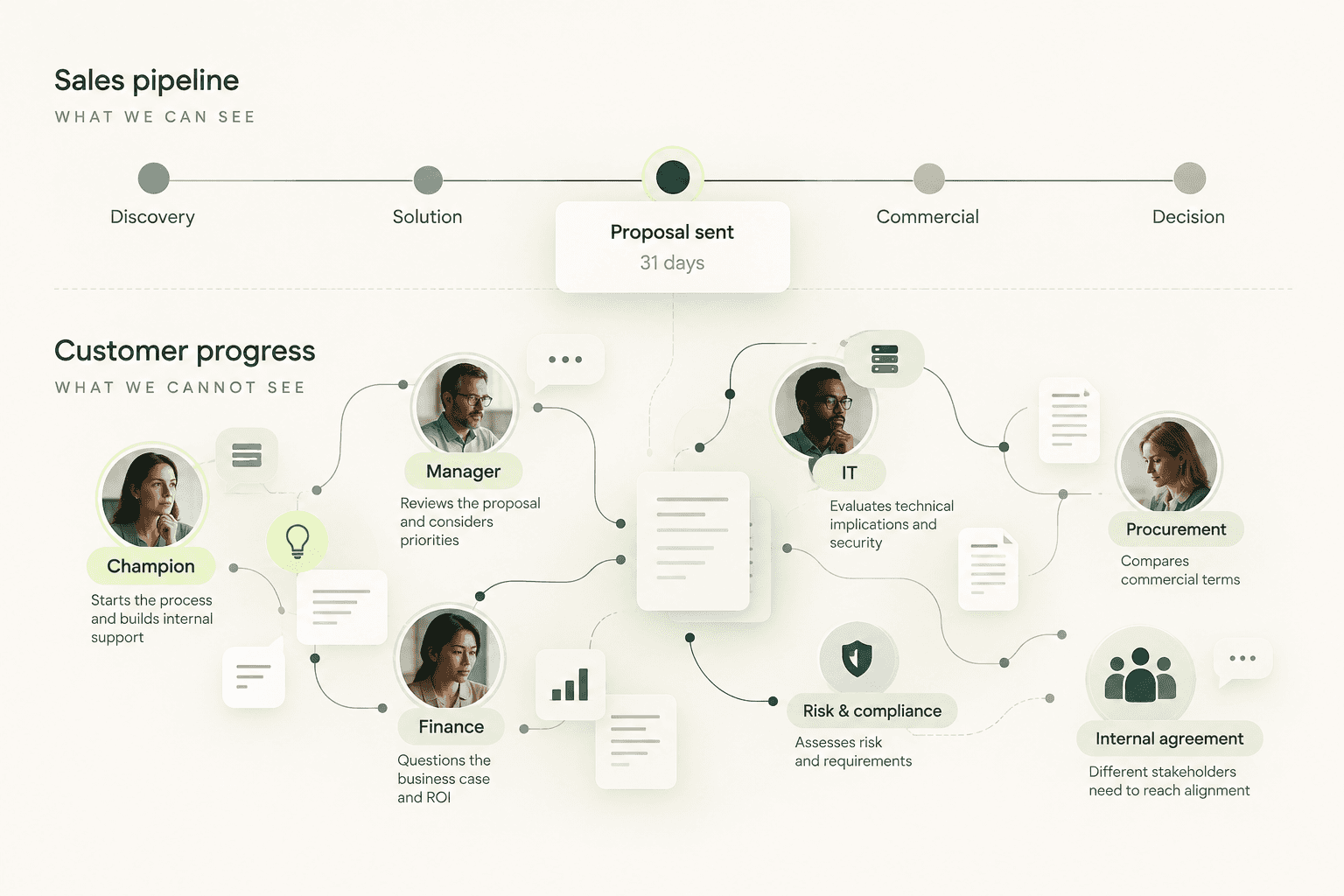
Your CRM says the opportunity has not moved for three weeks.
The proposal has been sent. There is no new meeting booked. The opportunity is still sitting in the same pipeline stage.
From the company’s point of view, not much seems to be happening.
But inside the customer organisation, quite a lot might be.
The person you have been speaking with may be discussing the proposal with their manager. Finance may be questioning the business case. IT may be looking at the technical implications. Procurement may be comparing commercial terms.
Someone who has not joined a single sales call may suddenly become important to the decision. And the person leading the evaluation may still be asking themselves whether solving the problem is important enough to justify the cost, disruption and internal effort involved.
None of this necessarily changes the CRM stage. But all of it can affect whether the customer is able to move forward.
This is an important distinction in customer journey work:
Customer progress and pipeline progress are not the same thing.
Pipeline progress reflects the commercial milestones the company can see. Customer progress is about what has actually changed on the customer side — what people now understand, agree on or feel confident enough to do next.
Pipeline stages show the company’s view
A sales pipeline exists for good reasons. It helps a company manage opportunities, forecast revenue, focus sales effort and understand commercial progression.
But its stages usually describe milestones the company can see:
Discovery completed
Solution discussed
Scope agreed
Proposal sent
Commercial terms discussed
Closed
These tell us something useful about what has happened between the customer and the supplier. They do not necessarily tell us what has changed on the customer side.
A proposal can be sent while the customer is still uncertain whether the problem is worth solving. An opportunity can sit in the same CRM stage while the customer makes significant progress internally.
That is why pipeline movement on its own does not tell us how close the customer is to making a decision.
Much of the customer’s work happens where we cannot see it
Buying something complex in B2B usually involves far more than evaluating a vendor.
Customers may need to agree on what the real problem is and whether it is urgent enough to act on. They may need to bring different stakeholders into the discussion, build a business case, work through technical or operational implications and reduce enough risk to feel comfortable making a decision.
They may also be comparing very different alternatives not just Vendor A against Vendor B, but bringing in external expertise, building internally, changing a process, delaying the decision or doing nothing at all.
Much of this happens without the vendor being present. It happens in internal meetings, Slack messages, spreadsheets, budget discussions, informal conversations and individual thinking.
We see the meeting.
We see the proposal.
We see the email reply.
We do not necessarily see the five conversations that happened between those things.
This is one reason it helps to look at the customer journey beyond the individual interactions a company can see.
A stalled opportunity can mean very different things
A lack of visible pipeline movement can easily be interpreted as one problem:
The deal is stuck.
The customer has gone quiet.
We need to follow up.
Sometimes that is exactly what is happening. Interest has disappeared, priorities have changed or another option has won.
But sometimes the customer is still actively working on the decision.
Maybe the CFO is not convinced that the investment is worthwhile. The operational team may like the proposed approach but doubt whether they have the capacity to make it work.
The person leading the evaluation may need stronger evidence before they can recommend the decision internally. Or different members of the buying group may simply not have reached agreement yet.
So instead of only asking:
Why hasn’t the opportunity moved?
It is worth asking:
What does the customer still need to understand, resolve or feel confident about before they can move forward?
That question leads us somewhere quite different.
What has actually changed for the customer?
One way to see the difference is to compare company milestones with changes on the customer side.
A solution discussion being completed is something the company can record. On the customer side, the change may be that people now agree the current situation is no longer acceptable.
A proposal being sent is a commercial milestone. On the customer side, something has changed when there is enough internal support for the investment.
A technical approach being reviewed is an activity. On the customer side, progress may mean that the people involved have become sufficiently confident that the approach is feasible.
We need both views.
The pipeline helps us understand what has happened in our commercial process. The customer view helps us understand what still needs to change before people can move forward.
Progress is not the same as activity
There is another useful distinction.
Just because the customer is doing a lot does not mean the decision is moving forward.
More stakeholders may create alignment or introduce new disagreement. More analysis may increase confidence or reveal reasons not to proceed. A business case may unlock approval or show that the investment does not make sense.
So the aim is not to catalogue every customer activity and call it progress. It is to understand what needs to change before the customer can move forward.
Early in a buying process, that might mean agreeing that the status quo is no longer acceptable.
Later, it may mean reaching agreement on what a solution needs to achieve. Closer to a decision, it could mean building enough confidence in the value, feasibility and risk for someone to approve the investment.
This can change what marketing and sales do next
If we understand more of the customer’s hidden work, the practical implications can be significant.
A deal that appears to need another follow-up email may actually need evidence that helps someone defend the investment internally.
A buyer asking for another comparison may not need more information about the offering. They may be trying to build confidence among colleagues with different concerns.
And a long period between proposal and decision may not simply be a sales execution problem. If the same pattern appears repeatedly, it may show that customers consistently struggle to justify the investment, understand the proposed approach or feel confident about implementation.
That is useful beyond one opportunity.
If the same issues keep showing up, they can change what the company provides earlier: stronger proof, business-case material, stakeholder-specific content, customer stories, implementation information, different sales conversations or, in some cases, changes to the offering itself.
That makes journey understanding useful for more than describing what customers do. It can help the company decide what to do differently.
CRM tells you something important. It just does not tell you everything.
Companies need pipelines. They need stages, forecasts and clear commercial processes.
But customers have their own work to do, and much of it happens outside the company’s view.
Understanding that work can explain why a healthy-looking opportunity slows down, or why a deal that looks stalled may still be moving on the customer side. It can also stop us from assuming that the answer is always another sales activity.
So when an opportunity has been sitting in the same stage for weeks, the most useful question may not be:
How do we move this deal to the next stage?
It may be:
What does the customer need to make progress from where they are now?
*****
If you want to understand what customers are working through beyond what your pipeline can see, customer interviews are a good place to start. I can help turn those conversations into a clearer view of the buying journey and what your marketing and sales could do differently.